The consequences of Chromebook usage in education
Welcome to Out of Bound’s very first post! Out of Bound aims to analyze the effects of modern tech companies to help you break free from their consequences. If you want to learn more about where you’ve landed, you can read more about this site’s motives and technical details here. But, with this being a first post, I feel the most fitting thing to write about is the object that inspired this site to come to be in the first place: Chromebooks.
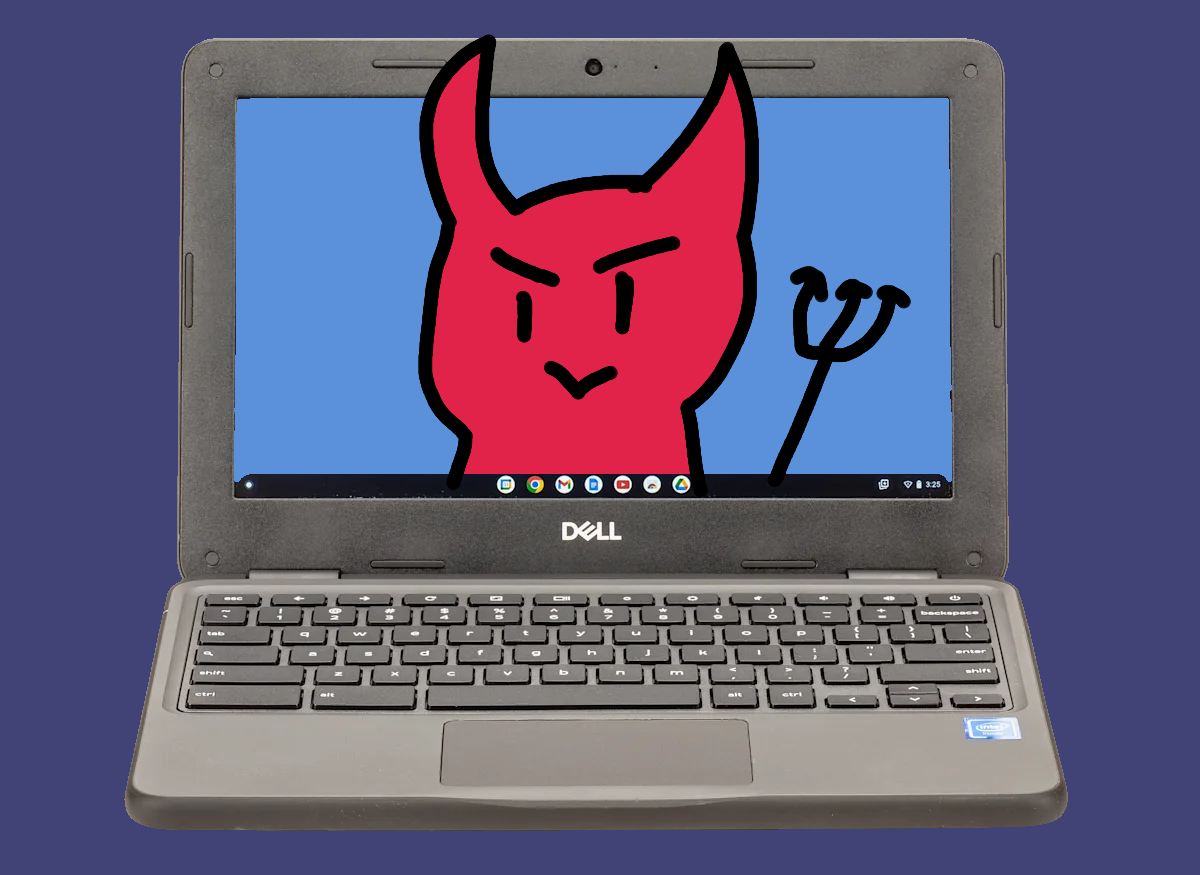
Over half of schools in the US provide a Chromebook to each student, including both of the school districts I worked in. Any educational benefits the students could have received were completely outweighed by how the Chromebooks were used in practice. Oh, the amount of times I walked into a classroom just to see at least three quarters of the students on some sort of game!
Every school is legally requiredIt's technically not a blanket legal requirement, but it effectively is. Any school who receives E-rate funding for technology is required to have web filtering through a law called CIPA, and 95% of schools receive E-rate funding. to have web filtering software that makes sure students don’t access pornographic or obscene content. The two big companies in this space are GoGuardian and Securly. GoGuardian alone is used by roughly half of schools in the US. These web filters can be configured to detect and block game sites in addition to other harmful content, but they simply do not do this well. Students frequently find new game sites and share them amongst each other, leading to teachers submitting tickets to the IT department to manually block the latest game site. And while these companies should allow teachers to easily view what students are doing on their Chromebooks, this feature commonly breaks on GoGuardian. Rather than relying on web filtering software to do the job, teachers have to submit a flood of website blocks to IT, and IT has to spend their time manually blocking websites one by one.
But the issue is worse than bad web filtering software. With so many students accessing game sites and other distractions, it’s worth wondering why teachers aren’t using more traditional paper methods instead. This is where the true damage of Chromebooks becomes obvious: rather than being a convenient option for teachers, they slowly become the only choice for them.
Consider what it means for a student to receive a Chromebook at school. Typically, a school has invested a significant amount of funds into purchasing Chromebooks for each student. Budgets that were originally used on paper curriculum are slowly repurposed for digital curriculum. Teachers will frequently have restrictions placed on their printing, forcing them into using Chromebooks for chunks of their curriculum. Or teachers can be required to post most, if not all, of their curriculum digitally. Teachers can be forced into long workshops for programs that are slowly proving to be near ineffective for students (such as iReady, a commonly used math program), and then be required to use this software to teach their students. This is despite the fact that it has been proven for quite some time that writing is better for memory than typing, that students learn better from print books rather than e-books, and that typing doesn’t train important fine motor skills that young children need. These restrictions and requirements are placed on teachers to fit the constraints of a budget stretched thinner by technology, not to ensure that teachers have better tools to do their job.
Why does this happen? It starts with good intentions, of course! The goal of a school is to teach students. All departments within a school automatically inherit that goal, including the IT department, but the IT department only knows how to teach through the use of technology. Since IT departments almost never have pedagogical training, they defer to experts for advice instead. Google then inserts itself as an authority figure, claiming that if every student receives a Chromebook, they could learn more with it than through traditional paper methods. They would be able to collaborate with each other more easily, and they’d have fewer books to carry around, and they could do independent research, and it integrates well with Google Classroom (which most schools already use)! And, when every other school is doing it, how could you not? This is the vicious cycle that leads to Chromebooks assigned per student and a shrinking physical materials budget.
An FCC statement from Brendan Carr puts it best:
The data shows that more than half of students now use a computer for up to four hours a day, and a quarter of them spend more than four… For their part, many tech companies supported the surge in screen time, benefiting from increased device sales.
There is a clear association between higher screen time and lower standardized test scores. When Chromebooks are the only way to learn, they are harmful to a student’s education. When students walk in with screen addictions from home, we can’t blame them for giving them a screen that can access games if they search 'unbloccked gammes'Most schools block the search 'unblocked games'. So students purposely misspell the search, letting Google automatically correct it, which gets around the block. enough times. When students don’t know proper grammar after Google Docs automatically corrected their mistakes and spelling, we can’t blame them for not paying attention in class or teachers for not teaching better. And when they graduate and get office jobs, we can’t blame them for not understanding how files and applications work after using a device that abstracts these away for twelve years. Technology has a role in a classroom, but technology can never be the whole of a student’s education.
–
I can share a range of stories, but the one that stuck with me most is very simple. One time, the Wi-Fi went out in a classroom, and I stopped into the room to see the situation. The mood was as low as it could be. The students had a test the next day, and were just about to do a study quiz on their Chromebooks. Of course, with the Wi-Fi out, the students couldn’t do much of anything. I restarted the access point and came back a few minutes later to see that the students were now yelling over each other in excitement. While she was waiting, she had put all the kids in groups, gave them whiteboards, and quizzed them herself. They were happily arguing over the material! No one cared that the Wi-Fi was fixed at all.
These are the exact moments taken away by Chromebooks. If you have any family members in school, whether they’re children, cousins, or anything else in between, try to learn the technology policies and practices of their schools. When their teacher assigns online math lessons that they cry over, understand that their teacher didn’t necessarily have a choice in assigning it. Request paper assignments if you can, and encourage others to do the same. Schools have already started transitioning away from Chromebooks, and others might just need a few pushes to consider moving away.